Give your patient the clinical story. We'll organize the filing around it.
Parity helps members prepare denial filings without turning your office into an appeals department. You contribute focused clinical context; the member reviews and submits.
Self-help document preparation · not legal advice · no patient referral or outcome promise
One-page provider contribution
What the reviewer needs to understand
- 1
Recommended level of care
What you recommended and when.
- 2
Why lower care was insufficient
Clinical facts, not legal conclusions.
- 3
Risk of interruption
What may happen if care stops.
- 4
Records to attach
Only what the member chooses to use.
Built to take minutes—not a second chart note.
Four roles. No blurred boundaries.
01
You document the care.
Use the focused template on your own letterhead.
02
The member builds the packet.
Parity organizes the likely route, draft, evidence list, and steps.
03
The member reviews and sends.
Nothing is filed automatically; the member remains the decision-maker.
04
The member records the answer.
The private case page shows the next route only after a confirmed event.
Why it matters.
Clear supporting material can help in three ways.
Your client gets a clearer way to challenge the denial.
A structured packet can make the requested care, denial, and supporting facts easier for a reviewer to evaluate.
You, the provider, can document medical necessity.
The provider template helps connect the requested care to recognized clinical standards without promising an outcome.
Both keep the supporting facts organized.
The client remains in control of the filing while the provider supplies only the clinical support they choose to share.
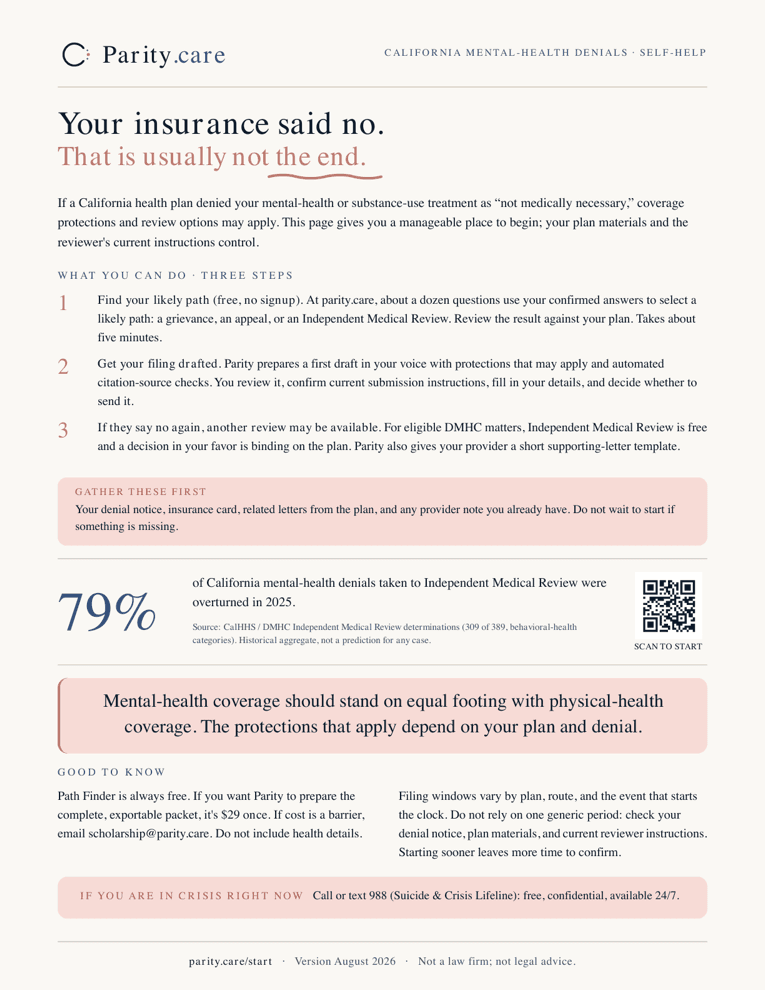
of California mental-health denials taken to Independent Medical Review in 2025 were overturned (309 of 389).
A state baseline for denials pursued all the way to review. Not a Parity outcome, and not a prediction for any individual case.
California Open Data, DMHC Independent Medical Review Determinations, 2025 — mental health, autism spectrum, and mental/behavioral/neurological categories. Baseline IMR data, not a Parity outcome. View the CalHHS dataset ↗
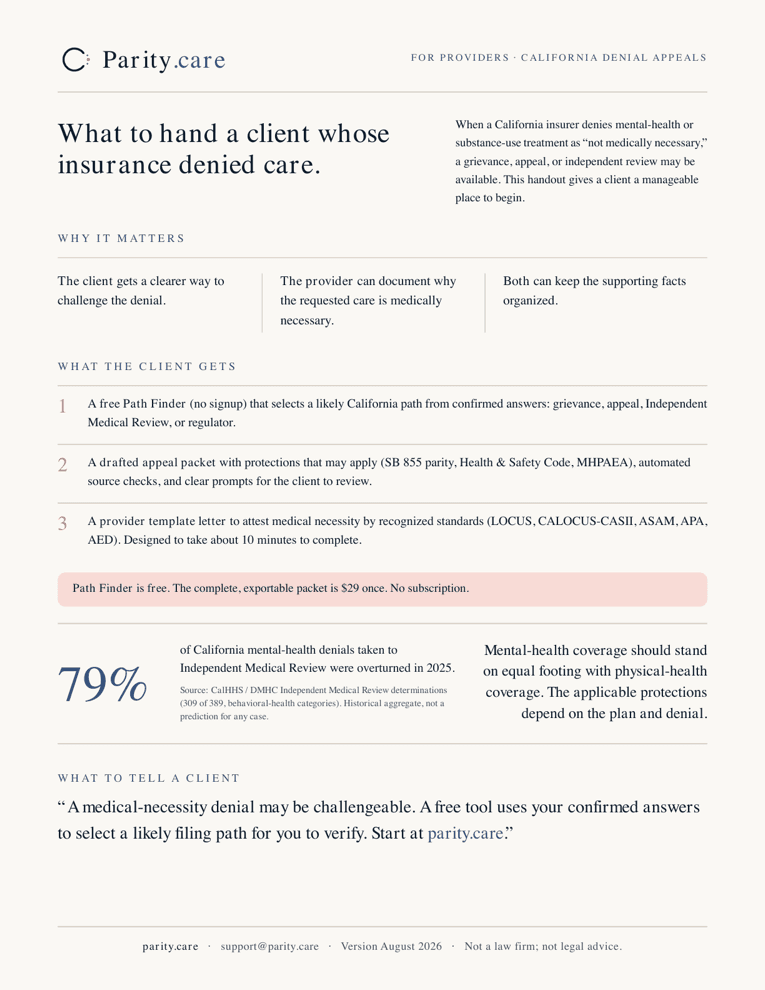
What to hand a client whose insurance denied care.
Your client may have a grievance or appeal path. Many California mental-health medical-necessity denials that reach the state's independent review are overturned. There's also a free tool that selects a likely filing from the client's confirmed answers.
Two printables: the client handout speaks directly to your client. Print it and hand it across the desk, so the denial does not read as the end of the road. The provider brief is the same story for you: what Parity is, what it drafts, and what to say.
A packet your client can actually use.
A free Path Finder (no signup, no account) that uses confirmed answers to select a likely filing path for the client to verify.
A drafted appeal packet with protections that may apply, automated citation-source checks, and clear prompts for the client to review.
A document checklist and route-specific submission steps for the client to confirm.
Access your client controls: one exportable packet is free for everyone. The
$29packet is $0, with no payment details.
A clinician template ships in every packet.
Every packet includes a structured template. The treating clinician decides what to complete, then reviews and signs it.
- Diagnosis and clinical presentation
- Why the requested care is medically necessary
- Why lower levels are insufficient
- Relevant LOCUS, CALOCUS-CASII, ASAM, APA, or AED prompts
The template leans on generally accepted standards of care, not any single insurer's internal rules.
Clinical bracketed fields stay in the provider's hands. This is a starting point, not a finished clinical opinion.
Want to talk it through?
Reach us any time at support@parity.care. Or point a client straight to the free Path Finder.
Send them to Path Finder →No accountServer drafts auto-delete in 7 days; downloads are yoursAutomated citation checks, not legal review